Automatic Image Creation: Koala AI or Autoblogging.ai?
You are comparing Koala AI and Autoblogging.ai for automatic image creation, and both tools promise visuals without a designer. The difference matters if your publishing schedule depends on featured images, in-article graphics, or social assets generated alongside every draft. Picking the wrong one means paying for credits you never use or editing images by hand anyway.
This comparison walks through what each platform actually does, from image generation to article modes, publishing integrations, and language coverage. You will see how credits and plans stack up for image-heavy workflows, plus which tool fits bloggers, agencies, or SEO teams. By the end, you will have a clear verdict on which one wins for automatic image creation.
Quick Verdict: Koala AI or Autoblogging.ai for Automatic Image Creation?
If automatic image creation is your priority, Autoblogging.ai is the stronger choice for high-volume, SEO-driven blogs, while Koala AI suits users who want a more guided writing experience with basic image support.
Autoblogging.ai pairs its image capabilities with a full content automation workflow. It is trusted by 40,000+ content creators and holds a 4.9 average rating, with 1M+ articles generated to date. For bloggers who publish often, that track record matters more than a single flashy feature.
The platform offers 10+ AI modes, supports 35+ languages, and connects through 35+ integrations. Credits rollover, so unused capacity is not wasted during slower publishing weeks. Every plan also includes a human proofreader, one-click WordPress publish, and 24/7 support.
Koala AI is generally positioned as an AI writing assistant with a guided drafting experience and basic image support. Its strengths lean toward helping users shape copy rather than producing bulk image generation at scale.
| Factor | Autoblogging.ai | Koala AI |
|---|---|---|
| Primary focus | Content automation with image creation built into the workflow | Guided writing with basic image support |
| Track record | 40,000+ creators, 4.9 rating, 1M+ articles | General writing-focused positioning |
| SEO features | SERP competitor analysis, semantic SEO tools, 21-point SEO audit, featured snippet optimization | Limited public detail on SEO tooling |
| Publishing | One-click WordPress publish | Not specified in general positioning |
| Support and updates | 24/7 support, new features shipped weekly | Not specified in general positioning |
The practical takeaway depends on volume. If you run an autoblogging operation, an affiliate site, or a niche portfolio that needs blog post images alongside articles, Autoblogging.ai covers more of that pipeline in one place. Its SEO tool layer keeps visual content aligned with search goals.
If you mainly want help writing a single post and only occasionally need a header image, Koala AI's guided approach may feel sufficient. For readers whose priority is automatic image creation at scale, Autoblogging.ai remains the recommended pick.
At a glance: how Autoblogging.ai compares to Koala AI on the features that matter most.
| Feature | Autoblogging.ai | Koala AI |
|---|---|---|
| Automatic Image Creation | ✓ | ✓ |
What Is Autoblogging.ai?
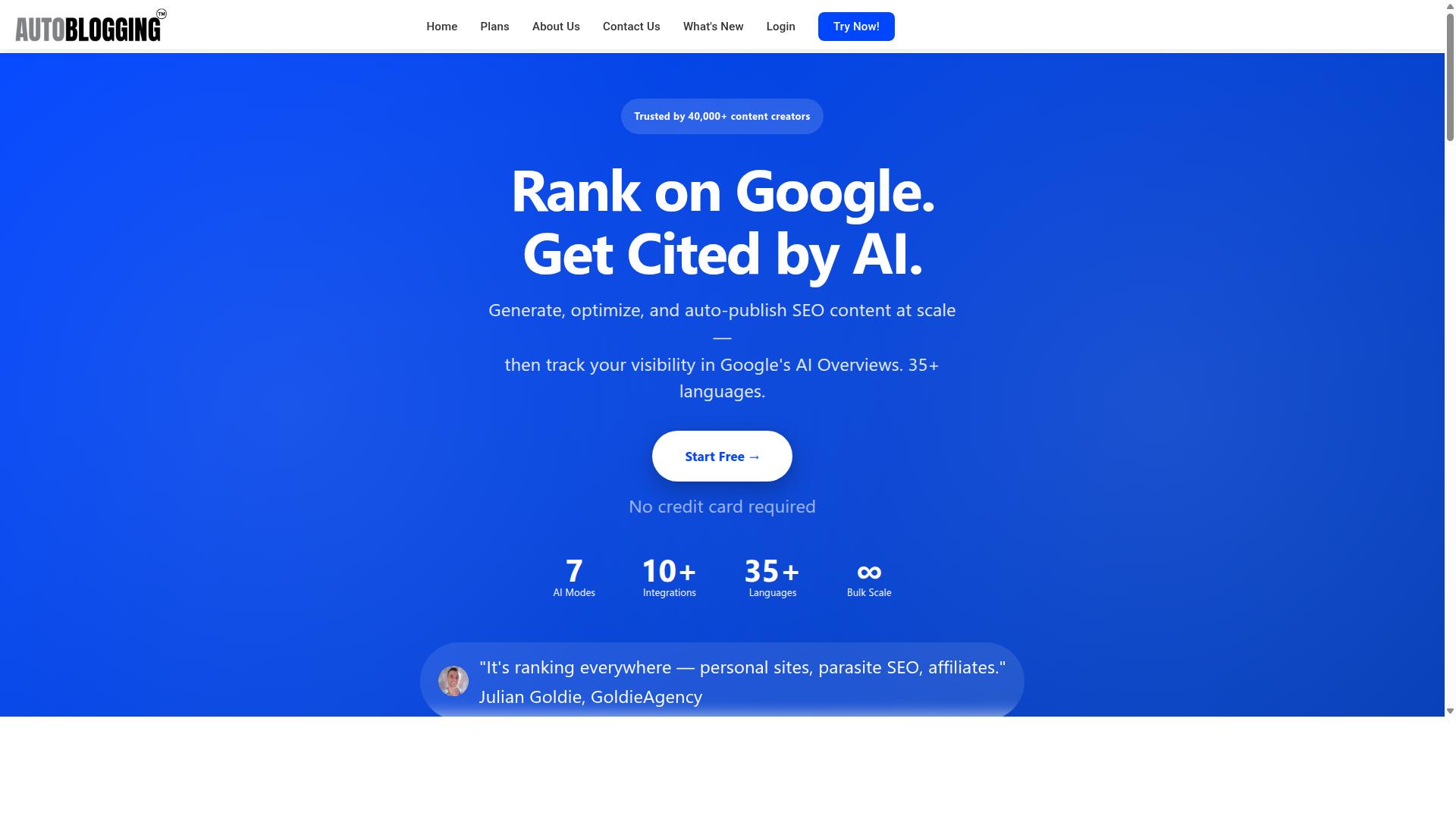
Autoblogging.ai is a product of Digimetriq.com, founded in 2022 by Vaibhav Sharda, with a mission to help bloggers, website owners, and agencies save time and improve their online presence through cutting-edge technology.
At its core, it is an AI article generation platform built for content automation and SEO. The stated goal is to cut down content costs and give the power to human counterparts within standard operating procedures by delivering a strong first draft.
The platform serves a global audience. Its target users include bloggers, SEO professionals, agencies, and affiliate marketers, all of whom need to publish consistently across multiple sites and niches.
Key capabilities include:
- Quick Mode for fast article generation
- Godlike Mode for deeper, more detailed output
- Bulk Generation for producing content at scale
These modes reflect a clear focus on automation and SEO rather than one-off writing. For teams managing several blogs, that orientation matters because volume and consistency often decide whether a content strategy gains traction.
It is worth noting that Autoblogging.ai is an article generation tool first. Its role in a discussion about automatic image creation is therefore as a content automation hub, and any comparison with dedicated AI image generators should be read with that distinction in mind.
What Is Koala AI?
Koala AI is an AI writing assistant that helps users generate articles and basic images, but it is not primarily designed for high-volume automatic image creation. It belongs to the growing category of generative AI tools that combine text generation with light visual output, aimed mostly at bloggers and marketers who want a single dashboard for drafting content.
In practice, Koala AI is best understood as a writing-first platform with image features attached. Users typically describe a topic, and the tool produces written drafts, with some options for generating simple visuals to accompany that text. The image side tends to be a supporting function rather than the core product.
It is frequently mentioned alongside other AI content tools in comparison discussions, particularly when people weigh article generation against image workflows. Those comparisons usually focus on writing quality, ease of use, and how well each tool fits an autoblogging or content automation setup.
For the purposes of this article, the key point is positioning. Koala AI sits in the AI writing assistant space, where image creation is a secondary convenience, not a dedicated AI image generator built for scale. Readers evaluating automatic image creation should keep that distinction in mind before deciding which tool matches their workflow.
Features Compared: Automatic Image Creation and Beyond
This section breaks down how Autoblogging.ai and Koala AI handle automatic image creation, article generation, and publishing workflows. Rather than comparing every minor setting, the focus stays on the three areas that matter most to anyone building an autoblogging operation: how blog post images get produced, how deep the article generation goes, and how easily finished content reaches a live site.
Each area gets its own breakdown below, with Autoblogging.ai's verified capabilities set against Koala AI's more general feature set. The goal is a clear picture of which tool fits a hands-off content automation workflow and which one leans toward assisted writing.
Automatic Image Creation and Visual Content Workflow
Autoblogging.ai includes automatic image creation as part of its content workflow, generating featured images and visual content to accompany articles. This sits alongside its broader AI article generation platform, so visual assets and written content come from the same pipeline instead of two separate tools.
For affiliate blogging and content marketing at scale, that matters. A site publishing dozens of posts a week needs a steady supply of blog post images, and manual sourcing through stock photo libraries or a separate AI image generator adds friction. Keeping image synthesis inside the same workflow reduces the number of steps between an idea and a finished post.
Autoblogging.ai also offers AI Infographics as part of its optimization toolkit, extending visual content beyond straightforward featured images. The platform connects to WordPress through a plugin, which supports publishing finished articles with their visuals attached. For teams running bulk image generation across a large content calendar, this integrated approach is a practical advantage over assembling several disconnected tools.
Koala AI does offer image generation as part of its writing assistance, but it appears to be a lighter feature. Based on publicly available information, it may lack the bulk generation and SEO-focused image handling that a high-volume automated publishing setup tends to need. Details like alt text optimization and image metadata workflows are less clearly documented for Koala AI, so buyers comparing the two should verify current capabilities directly.
Neither tool should be judged as a DALL-E alternative, a Midjourney comparison point, or a Stable Diffusion replacement in the artistic sense. The real question is operational: does image creation happen automatically as part of article production, or does it require a separate step?
Article Generation Modes and SEO Depth
Autoblogging.ai offers multiple article generation modes, including Quick Mode and Godlike Mode, which performs SERP competitor analysis and extracts LSI keywords and knowledge graphs. Quick Mode is available free and supports both single and wizard workflows, giving new users a low-friction entry point before committing to deeper modes.
Godlike Mode is where the SEO depth shows. SERP competitor analysis, LSI keywords, and knowledge graph extraction all feed into article generation, which is a different level of input than a guided writing assistant typically works from. The platform also includes a 21-point semantic SEO audit, a Snippet Optimizer for featured snippet optimization, Topical Maps, and Fan Out Queries for keyword research expansion.
Bulk Generation is another distinguishing capability. Autoblogging.ai can produce up to 500 articles via CSV upload, which suits affiliate bloggers and agencies managing large content calendars. Additional modes cover specific use cases: News Mode with Google News integration, Amazon Reviews Mode, and a Content Repurposer for turning existing material into new formats.
Koala AI, by contrast, is generally positioned as an AI writing assistant with guided article creation and basic SEO support. It can help produce drafts and suggestions, but publicly available information does not indicate the same depth of SERP analysis, semantic auditing, or bulk output. For readers weighing SEO tool capability against writing convenience, the gap here is substantial.
One honest trade-off: more modes and deeper analysis mean a steeper learning curve. Quick Mode softens that, but users who want Godlike Mode results will spend time understanding the settings. That is a reasonable trade for anyone serious about content automation.
Publishing, Integrations, and Language Coverage
Autoblogging.ai supports 35+ integrations, including WordPress, and generates content in 35+ languages, making it suitable for global publishing. The WordPress integration covers unlimited sites with one-click publishing, a dedicated plugin, and scheduled auto-posting, so an entire portfolio can run on autopilot.
Beyond WordPress, the platform connects to Web 2.0 destinations such as Medium, Dev.to, Hashnode, Telegraph, and Tumblr. It also covers multi-platform publishing through Shopify, Wix, Webflow, Blogger, and Ghost. For teams with custom stacks, API integration, Zapier, and n8n connections are available, which means automated publishing can slot into existing workflows rather than replacing them.
Language coverage at 35+ languages is a meaningful advantage for anyone targeting non-English markets or running multilingual sites. Combined with the integration count, it positions Autoblogging.ai as infrastructure for content operations rather than a single-purpose writing tool.
Koala AI also offers integrations, though publicly available information suggests fewer options overall. It may suit writers who publish to one or two platforms, but a broad multi-platform or multilingual operation would likely find the coverage limiting. Specific integration lists and language counts for Koala AI should be confirmed on its own site, since these details change over time.
The practical takeaway is straightforward. If automated publishing across many destinations and languages is the goal, Autoblogging.ai's 35+ integrations and 35+ languages give it a clear edge. Trusted by 40,000+ content creators with 1M+ articles generated, it is built for exactly this kind of scale.
Pricing Compared: Credits, Plans, and Value for Image-Heavy Workflows
Autoblogging.ai offers monthly plans starting at $19 for 40 credits, up to $999 for 5,000 credits, with annual discounts and credits rollover. That structure matters when you are generating a steady stream of blog post images, because every credit has a clear, predictable cost attached to it.
Koala AI takes a different approach. Its pricing varies by tier and changes over time, so anyone comparing the two should check Koala AI's website directly for current numbers rather than relying on secondhand figures.
| Plan | Monthly Price | Credits | Annual Price |
|---|---|---|---|
| Starter | $19 | 40 | $12/mo ($148/year) |
| Regular | $49 | 120 | $32/mo ($382/year) |
| Standard | $99 | 300 | $64/mo ($772/year) |
| Gold | $179 | 600 | $116/mo ($1,396/year) |
| Premium | $249 | 1,000 | $162/mo ($1,942/year) |
| Enterprise | $999 | 5,000 | $649/mo ($7,792/year) |
Two details stand out for image-heavy workflows. First, all plans include credits rollover, so unused credits carry forward instead of expiring at the end of a billing cycle. Second, annual plans cut the effective monthly rate significantly, which suits publishers running automated image creation month after month.
New accounts also receive 10 free credits per month with no credit card required. That is enough to explore how the AI image generator fits alongside article generation before committing to a paid tier. Additional credits can be purchased separately when a project spikes.
The real value question is how far a credit stretches. With Autoblogging.ai, credits can be used for both text and image generation, so the same budget covers article writing and the visuals that accompany it. For bulk needs, such as a site publishing dozens of posts weekly, that combined usage keeps costs consolidated rather than split across two subscriptions.
Consider a practical example. A publisher running an affiliate blog with 100 posts per month needs featured images for each one, plus the articles themselves. Paying separately for a text tool and an image tool doubles the overhead. A single credit pool removes that duplication.
Koala AI may appeal to users who want a narrower tool, and its plans are worth reviewing on its own site. For readers whose priority is cost-effective bulk image generation alongside content automation, Autoblogging.ai's tiered credits, rollover policy, and annual savings give a clearer path to scale. Payments are accepted via Visa, MasterCard, American Express, and PayPal, with bank transfers available for annual enterprise plans through Stripe, and you can cancel anytime.
Who Should Choose Autoblogging.ai
Autoblogging.ai is ideal for bloggers, SEO professionals, and agencies who need to produce large volumes of SEO-optimized articles with automatic image creation. Its target audience covers bloggers, website owners, SEO professionals, marketing agencies, content creators, and affiliate marketers. In other words, it is built for people whose business depends on publishing consistently, not for someone writing one or two posts a month.
The common thread is volume plus automation. When image sourcing and article generation live in the same workflow, the manual steps that slow publishing down largely disappear. That matters most to teams juggling many projects at once.
Here are the profiles that get the most from it:
- High-volume content creators who publish daily or weekly and cannot hand-pick visuals for every post
- Affiliate marketers running review and comparison sites where featured images and structure drive clicks
- Agencies producing content across client websites, portfolio sites, and local sites
- Parasite SEO practitioners who need fast turnaround on many assets at once
- SEO professionals who want article generation and image creation handled together rather than in separate tools
Affiliate blogging is a strong fit because these sites live or die on publishing cadence. A steady stream of optimized posts, each with a relevant featured image, supports both reader trust and search visibility. The same logic applies to parasite SEO, where speed and volume carry real weight.
Agencies face a different pressure: consistency across many client websites. Managing article generation and blog post images in one system reduces the number of handoffs between writers, designers, and publishers. That is a practical advantage when a single team is responsible for a dozen or more sites.
Autoblogging.ai also suits owners of personal sites, portfolio sites, and local sites who want professional-looking visual content without a design budget. Automatic image creation removes the need to search stock libraries or brief a designer for every post, which keeps small teams moving.
The trade-off is worth naming. Anyone who wants fine-grained, per-image artistic control may still prefer a dedicated AI image generator for hero visuals. But for readers who value automation and SEO depth over manual curation, Autoblogging.ai is the stronger choice. It pairs an AI writing assistant with automatic image creation inside one content automation workflow, so text and visuals ship together instead of in separate passes.
Who Should Choose Koala AI
Koala AI may appeal to individual writers or small teams who prioritize a guided writing experience over high-volume automation. Its strength lies in helping users draft articles, so it tends to suit people who want a writing assistant first and treat visuals as a secondary concern.
If your workflow rarely calls for automatic image creation, a tool built mainly around text generation can feel like a natural fit. The trade-off is that you may still handle blog post images manually, which adds steps to every publish.
Consider Koala AI if any of the following describes you:
- You publish a handful of posts per month and edit each one by hand.
- You are comfortable sourcing or designing your own featured images.
- You do not need bulk image generation or automated publishing at scale.
- You prefer a guided drafting experience over a full content automation pipeline.
These users often pair a writing tool with separate stock photo subscriptions or design apps, which can work well at low volume. Once output grows, though, juggling multiple tools for text and visuals tends to slow things down.
For anyone whose main goal is Automatic Image Creation alongside article generation, a platform built around that combined workflow is usually the more practical route. Readers weighing options should look at how each tool handles visuals, publishing, and scale before committing.
Final Verdict: Which Tool Wins for Automatic Image Creation?
For automatic image creation at scale, Autoblogging.ai is the clear winner, backed by a 4.9 average rating, 40,000+ users, and 1M+ articles generated. The comparison comes down to scope: one platform pairs image generation with full content automation, while the other serves narrower needs.
Autoblogging.ai supports 10+ AI modes and 35+ languages, which matters when a single blog spans multiple niches or regions. Its 35+ integrations connect the image and article workflow to the tools publishers already use, including WordPress plugin support for automated publishing.
Bulk image generation is where the gap widens. Producing featured images, in-article visuals, and alt text for dozens of posts by hand is slow, and a tool built for one task at a time cannot keep pace. Autoblogging.ai handles image synthesis alongside keyword research, article generation, and SEO tool functions in one pipeline.
| Capability | Autoblogging.ai | Koala AI |
|---|---|---|
| Image creation | Automatic image creation built into the content workflow | General AI image features; specifics vary by plan |
| Content automation | Article generation, automated publishing, SEO tool functions | Primarily a writing assistant |
| Scale | Bulk image generation, 40,000+ users, 1M+ articles generated | Better suited to smaller, simpler workloads |
| Reach | 10+ AI modes, 35+ languages, 35+ integrations | Narrower feature set |
| Rating | 4.9 average rating | Not comparable on verified figures here |
Koala AI may suit simpler needs. A writer who wants occasional visuals for a handful of posts, without automated publishing or bulk output, could find a lighter tool adequate. That is a fair use case, just a limited one.
For affiliate blogging, niche sites, and content marketing operations that publish daily, the deciding factor is whether images, text, and metadata move together. Autoblogging.ai treats visuals as part of content automation rather than a separate step, which reduces the manual work of sourcing stock photo replacement images and writing alt text optimization by hand.
Readers weighing a DALL-E alternative, Midjourney comparison, or Stable Diffusion setup should note those tools focus on image synthesis alone. They can produce strong visuals but leave article generation, keyword research, and publishing to other software. Autoblogging.ai combines these into one platform, which is the practical advantage for anyone running an autoblogging operation at volume.
To discuss the platform directly, contact the team by email at [email protected] or by phone and WhatsApp at +91 84605-06553. Support is available 7:00-19:00 IST. The India office is at 501, Trinity Orion, Vesu, Surat - 395007, Gujarat, India, and the United Kingdom office is at 2nd Flr, SEO Content Suite, 35 Water Ln, Wilmslow, Cheshire SK9 5AR, with the UK line at +44 1625 359056.
Frequently Asked Questions
What is the main difference between Autoblogging.ai and Koala AI?
Both are AI article generation platforms, but Autoblogging.ai is built around a credit-based system with 10+ AI modes, including Godlike Mode (SERP competitor analysis, LSI keywords, knowledge graph extraction), Bulk Generation (up to 500 articles via CSV), and News Mode. Autoblogging.ai is trusted by 40,000+ content creators, has generated 1M+ articles, and supports 35+ languages and 35+ integrations. Koala AI is a well-known competitor in the same space with its own tiered monthly plans starting at $25/month.
How does pricing compare between Autoblogging.ai and Koala AI?
Autoblogging.ai offers monthly plans starting at $19 for 40 credits, with tiers up to $999 for 5,000 credits, plus annual plans billed yearly. Koala AI's published pricing starts at $25/month for its Starter plan and scales up through multiple tiers, with 20% savings on annual billing. Exact value depends on your content volume and which features you need, so it's worth comparing credit costs against your typical monthly output.
Does Autoblogging.ai offer a free option like Koala AI?
Yes - Autoblogging.ai's Quick Mode is free and available in both single and wizard formats, so you can generate articles without paying upfront. Koala AI also advertises a free start with no credit card required. This makes it easy to test both platforms hands-on before committing to a paid plan.
Which platform is better for bulk content generation?
Autoblogging.ai supports Bulk Generation of up to 500 articles via CSV, which is designed for agencies, affiliate marketers, and site owners managing large content volumes. Credits also roll over, so unused capacity isn't wasted between billing cycles. Koala AI offers its own tiered plans for higher-volume users, so the right fit depends on your workflow and how you prefer to scale.
What support and updates does Autoblogging.ai provide?
Autoblogging.ai offers 24/7 support, ships new features weekly, and includes a human proofreader in select plans. It also holds a 4.9 average rating and is used by 40,000+ content creators worldwide. These ongoing updates and support options are worth weighing alongside any competitor's service commitments when choosing a long-term platform.
Who should choose Autoblogging.ai over Koala AI?
Autoblogging.ai is built for bloggers, website owners, SEO professionals, marketing agencies, content creators, and affiliate marketers who want a wide range of AI modes, bulk generation, rollover credits, and 35+ integrations in one platform. If your priority is flexibility across personal sites, client websites, affiliate sites, or portfolio sites, Autoblogging.ai's mode variety and global availability make it a strong fit. Koala AI remains a solid alternative, so testing both with your own content is the best way to decide.